Civil Defense Perspectives March 2026 (vol. 41 #2)
The laws of physics have not changed. Neither have the effects of nuclear weapons or the means for protecting against them. Only the likely scenarios for use have changed. Previously, an all-out Soviet attack was postulated, and maps of expected fallout distribution were disseminated. Today, part of the strategic triad may be obsolete—in fact, we may be mostly relying on submarines (CDP, November 2022, tinyurl.com/4zwn55bp). Bombs from rogue actors may already be prepositioned.
While the U.S. is waging war against the possibility that Iran might get a nuclear bomb, there is seemingly little concern about a bomb it might already have, or the thousands that others including Iran’s allies definitely do have now (https://tinyurl.com/5h44cfdh). There has not been a run on scarce radiation monitoring equipment—yet (ki4u.com).
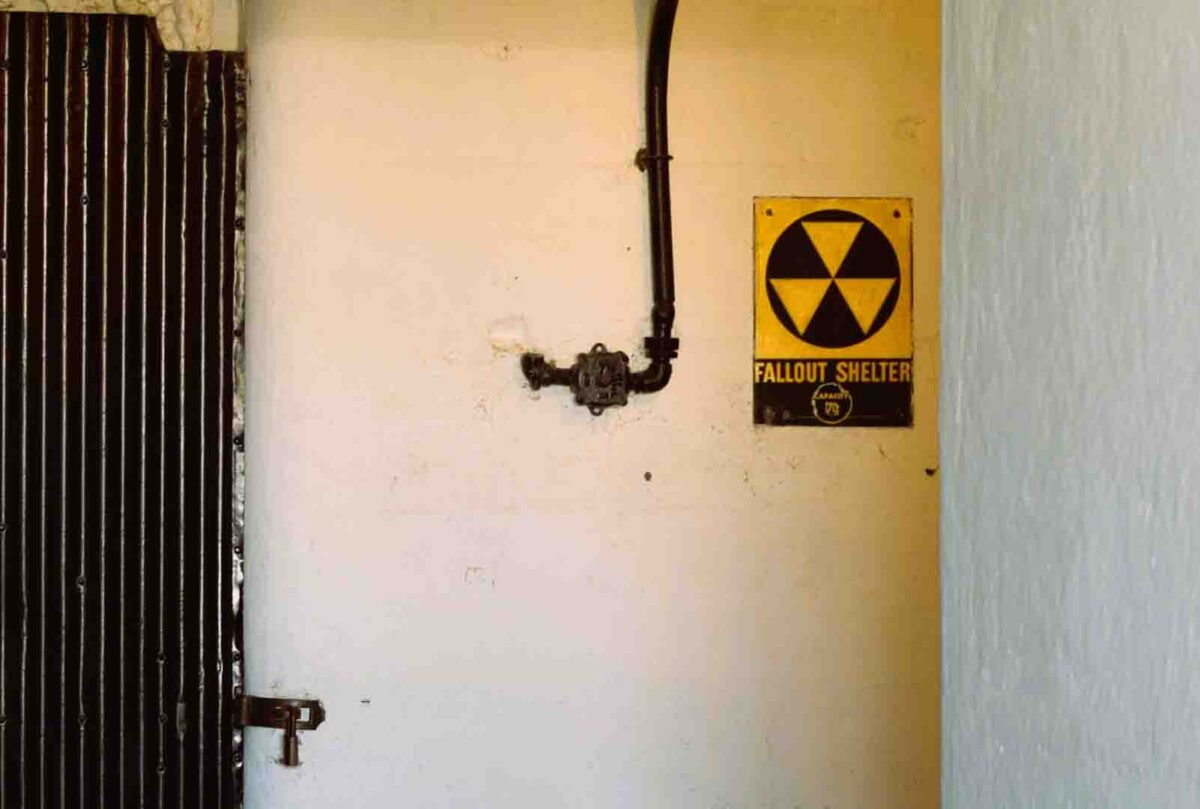
Physical remnants of 1950s civil defense are mostly gone (though billionaires are building elaborate bunkers). Worse, information available to the public from both government and private sources is limited and often unreliable. Hence, a review as well as an update is in order.
If you see a bright flash, drop and cover.
The only warning you might get of a devastating blast wave following in a few seconds at nearly the speed of sound is the initial blinding light. American cities no longer have sirens. According to the experts such as the late Conrad Chester, this would save more lives than anything else. Children in school would be saved from flying glass shards, as they were during the 2013 Chelyabinsk meteor explosion (tinyurl.com/mpbz9vdv).
If you are in the open, this maneuver helps to protect you from flying debris. It takes a 100-mph wind to knock a person down while standing, but about a 300-mph wind to blow him away if he is lying down. Keep your eyes closed. Any shadow or cover, even thin clothing, leaves, or a newspaper, protects against flash burns. Wearing white cotton underwear (such as Mormon garments) may protect you. One soldier’s life was thus saved in Hiroshima when his outer clothing instantly burned off. Lying prone may also reduce initial radiation exposure because there are likely to be more obstacles such as building foundations and cars between the person and the source of the gamma radiation.
According to a poster in the Hiroshima Museum, no policemen died in Nagasaki because a policeman who survived Hiroshima brought them the message that a bright light would be followed within seconds by a deadly shock wave.
Make copies of the 60-second training card (https://tinyurl.com/33uyukez).
Radiation Exposure
Intense radiation is released in the detonation of the bomb. This is an instantaneous exposure, like an X-ray, and does not make things radioactive. Changing clothes or showering would have no effect. If the weapon is ground burst, clouds of dust and debris mix with radioactive materials from the bomb and drift down to earth. Fallout is visible, looking like sand, grit, or ash. It emits harmful gamma radiation and can contaminate water and food. Food and water in containers is safe; just clean the outside.
The government is reportedly commandeering supplies of the “anti-irradiation” drugs potassium iodide and Prussian blue. These drugs do not treat the effects of radiation. KI is taken up by the thyroid gland and blocks the absorption of radioactive iodine. Prussian blue binds cesium and thallium in the intestines, hastening their excretion. Thus, these drugs protect the body if contaminated food or water is ingested. Preferably, one should avoid the ingestion.
If one has radiation sickness, the treatment is for damage to the immune system, gastrointestinal tract, and bone marrow that causes infections, dehydration, and bleeding. The goal is to prevent death from complications until the body recovers. The severity depends on the dose received. At less than 100-200 rads, patients are likely asymptomatic. The speed of onset of vomiting and diarrhea is a rough indicator of the dose. Above 600 rads, death is virtually certain. Patients with bone marrow failure may require advanced medical treatments such as a marrow transplant. Most people who were outside the zone of complete destruction, where they would probably die from the blast, would likely survive the initial radiation dose.
Limiting exposure is key: this requires shelter.
One person survived at Hiroshima in the basement of a reinforced concrete building a mere 170 m from Ground Zero, and lived into his early 80s. To get to a blast shelter requires warning. But there is a little time to find or improvise shelter while awaiting the arrival of fallout.
Distance and mass between the fallout and the people provide protection. The middle of a building is safer than next to an outside wall. Shielding by various materials depends on their density. To reduce the dose by half requires 3.6 inches of soil, 2.2 of concrete, 0.7 of steel, 4.8 of water, and 0.8 of lead. Ten half-value layers (e.g. 36 inches of soil) reduces the dose to 1/1000 of the outside dose. Cresson Kearny demonstrates an expedient “core shelter” that can be quickly constructed in your house (https://tinyurl.com/y7uccnrj).
The radioactivity in fallout decays rapidly, by the 7/10 rule. After 7 hours, the dose is 10% of the level after detonation and falls by 90% for each 7-fold increase in time. It would be 1% in 49 hours and 0.1% in 2 weeks. Of course, it would be desirable to know the actual dose. Those who are serious about preparedness have a suitable instrument (ki4u.com) or have made a Kearny Fallout Meter as described in Nuclear War Survival Skills (www.oism.org/nwss or www.nuclearwarsurvivalskills.com).
Concern about exposure to low doses is based on the hypothetical increased risk of cancer years later—and can be used to thwart rescue efforts or work essential for survival. Yet a low dose could even enhance long-term survival if proponents of hormesis are correct. For regulatory thresholds and actual exposures, see https://tinyurl.com/b4xfhars (the proposed network of radiation monitoring failed for lack of interest). Maximal permitted public exposure in the U.S. is 100 mrem/yr; natural background is 200-300 mrem/yr. Dogs exposed to 110,000 mrad/yr for life had no increased tumor incidence.
The main threats to survival would be loss of infrastructure and shortages of food, water, and standard medical treatments.
Preparedness Review and Update
Remember the Chinese proverb, “When you’re thirsty, it’s too late to dig a well.”
There are options for food storage such as freeze-dried foods that offer a diet resembling what Americans are used to. But for long-term survival, cost-effectiveness and long shelf life are critical. Nuclear War Survival Skills provides excellent advice, along with practical methods, e.g., for carrying water.
The ultimate survival and endurance food is probably pemmican. It requires no refrigeration or preparation and lasts for decades (https://tinyurl.com/62ecr2e8).
“Forever” essentials you can add to in normal grocery shopping: sugar, honey, baking soda, salt, and “lite-salt” (with potassium chloride for oral rehydration).
And don’t forget to replace your outdated supply of batteries. These days they might be preferred barter items.
Medical Supplies
Of course, you should keep a supply of needed prescription medications. Most health “plans” permit only “just in time” refills. If your doctor will write the prescription, you can get it filled early if you pay cash. Don’t tell the pharmacist you have insurance. The cash payment might even be less than your co-payment. To check prices, go to goodrx.com. Physicians who practice “travel medicine” might be willing to write prescriptions, preferably for more than one episode of infections.
Based on recent information after COVID, there are a number of items you might want to add to your medical preparedness kit (https://www.ddponline.org/medkit/, revised 2021).
Some disinfectants are not effective against all pathogens, e.g. alcohol does not affect norovirus. An excellent nontoxic substitute is hypochlorous acid, HOCl. It can also be aerosolized to disinfect the air, and used in nasal sprays and wound care products. Its main disadvantage is instability. Stabilized products are available with a shelf life of a year or more. For use in a large area such as a dental or oral surgery office, it may be more economical to generate it on site by electrolysis of non-iodized salt in water (tinyurl.com/yw8uud23). It is effective against SARS-CoV-2, and currently offers a solution to the hantavirus problem on a cruise ship (https://tinyurl.com/4xxcc2bv).
Also useful in purifying air and water (https://tinyurl.com/mw4fs3rm) is chlorine dioxide (ClO2)—which is not “bleach.” It is widely used worldwide for water treatment. In 2001, it was used to decontaminate government buildings contaminated with anthrax spores, without damaging buildings or furnishings. It is extremely safe, but may be called “poison” when suggested as a therapeutic agent. NASA once called it “a universal antidote” (https://tinyurl.com/4z24bwpb). Some speculate that it could negate efforts to find biological warfare agents, and this might explain extremely aggressive efforts to suppress reports of efficacy in a wide range of conditions including malaria, AIDS, and tuberculosis (The War on Chlorine Dioxide, https://tinyurl.com/85kvrnma, not available on amazon). It might offer hope against antibiotic-resistant bacteria.
Unlike most U.S. pharmaceuticals, ClO2 does not depend on a supply chain starting in China. You can generate it yourself by mixing a 25% sodium chlorite (NaClO2) solution and an acid solution such as 50% citric acid or 4% HCl, from a kit made by Crystal Clear Lab (available on amazon). But how much do you use? You can determine the concentration of the solution, but stomach acid will create more. Determining the dose to take is a matter of trial and error. There are no standardized, regulated formulations available from a pharmacy. Physicians cannot and will not prescribe it; patients are self-prescribing at their own risk.
The NOAEL (no observed adverse effect level) for chlorite (equivalent to ClO2) is 3 mg/kg/day (tinyurl.com/m3h29696). Combining l ml (20 drops) sodium chlorite with 1 ml HCl gives 125 mg ClO2 (https://tinyurl.com/3yd2739h).
For references on safety and applications in The Interactive Reference Guidebook, see https://theuniversalantidote.com.
Steve Kirsch provides easy instructions for preparing a 1,000 ppm (1,000 mg/L) stock solution (tinyurl.com/mt3jtw7f). Protocols for oral use recommend sipping a dilute solution (say l ml or a dropper full in 100 ml distilled water) at hourly intervals over a day, based on tolerance and response. Kirsch uses Safrax DISIN-CLO2 tablets, intended for deodorizing spaces.
Topical ClO2 has been remarkably effective for wounds and burns (https://tinyurl.com/428pd9z2). Convenient formulations of gels and sprays are available from frontierpharm.com, clearly labeled “for veterinary use only.”
Ivermectin is now being promoted for many unapproved uses beyond COVID-19, including vaccine adverse effects and cancer. Results are anecdotal; hopefully, controlled studies will be done. It may still be difficult to get your doctor to prescribe a stockpile for you. It may be available from India without prescription by internet; price may be around $0.2/mg, but you can pay much more. People often resorted to veterinary products during COVID. Injectable Durvet IVM is about $0.03/mg and could be taken orally. IVM, as in “horse paste,” can also be applied topically, best behind the ear. Veterinary products may contain ingredients not suitable for humans, so check ingredients.
Dimethyl sulfoxide (DMSO) is a readily available product with many industrial uses. Its only FDA-approved use in humans is intravesical installation for interstitial cystitis. It is generally marketed for topical use in horses to treat pain and inflammation.
In the early 1960s, it was extensively researched. A New York Times editorial suggested that it was “the nearest thing to a wonder drug the nineteen-sixties have produced so far” (https://tinyurl.com/yvtsx2j2). Citing thalidomide, it warned about unsupervised use and advised patience, awaiting the results of orderly research. However, in 1965, the FDA not only banned all DMSO testing in the United States, but sent out global telegrams to each embassy encouraging other nations to do the same.
“A Midwestern Doctor” undertook to compile every relevant paper written on DMSO (https://tinyurl.com/464kwmnk). It is remarkably safe. An important feature is that it can carry antibiotics through the skin—and contaminants such as dyes. The number of conditions that have reportedly benefited is astonishing. Most pertinent for a post-nuclear attack is treatment of burns, wounds, and infections (https://tinyurl.com/u97njkrf). DMSO has antiviral (especially H. simplex and H. zoster) and anti-bacterial properties, and also increases sensitivity to antibiotics. It increases resistance to radiation if given prior to exposure, and may help to protect against damage from radiation therapy (https://tinyurl.com/52nzmtbz). Oral and IV administration is possible—using guess-at doses because of lack of research.
Medical use of the products mentioned above is against medical advice. One could store them, however, for a time when no medical advice or no pharmaceutical products are available, and they do have other uses.